
Stock
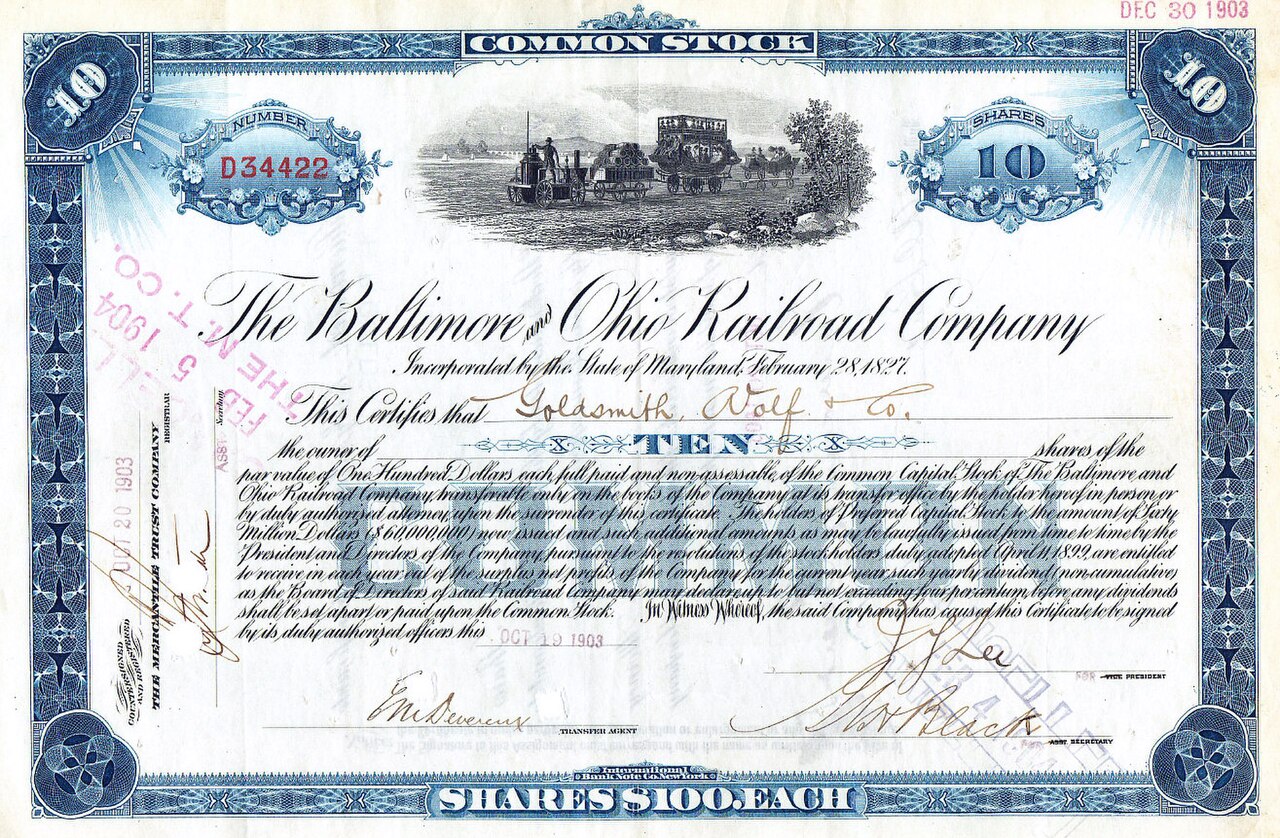
Shares represent fractional ownership in a corporation.

Wikipedia / Wikimedia Commons
Stocks, also called capital stock or shares, represent the division of ownership in a corporation or company. A single share entitles the holder to a fractional ownership proportional to the total number of shares, typically granting rights to earnings, liquidation proceeds, and voting power, though not all shares are equal. Stocks can be bought and sold privately or on stock exchanges, with private transactions closely overseen by governments and regulatory bodies to prevent fraud and protect investors.
- field
- Finance, Corporate Ownership
- known_for
- Representing fractional ownership in corporations; traded on stock exchanges and private markets
- types
- Common stock, preferred stock, convertible preferred stock, Rule 144 stock
- derivatives
- Stock futures, stock options (calls and puts)
- earliest_example
- Roman Republic publicani issued shares called partes and particulae
Lore & Background
The concept of stock dates back to the Roman Republic, where government contractors called publicani issued shares known as partes and particulae. Polybius noted that 'almost every citizen' participated in these government leases, and Cicero referenced shares that 'had a very high price at that time,' indicating price fluctuation and stock market behavior. Around 1250 in France, shares of the Société des Moulins du Bazacle were traded based on the profitability of its mills. In 1288, the Bishop of Västerås acquired a 12.5% interest in Great Copper Mountain, documented as a stock transfer in exchange for an estate.
Reader's Guide
Stocks are fundamental to modern capitalism, enabling companies to raise capital by issuing shares and allowing investors to own a portion of a business. The distinction between common and preferred stock affects voting rights and dividend priority, while convertible preferred shares offer flexibility. Rule 144 stock in the United States governs the resale of restricted and control securities, requiring specific conditions for liquidation. Stock derivatives, such as futures and options, allow trading based on underlying equity prices, with the Black–Scholes model commonly used to value options. The historical evolution from Roman publicani to the Dutch East India Company's tradeable shares on the Amsterdam Stock Exchange illustrates the long-standing role of stock in economic growth and investment.
Did You Know?
- In the Roman Republic, government contractors called publicani issued shares called partes and particulae.
- Around 1250 in France, shares of the Société des Moulins du Bazacle were traded based on the profitability of its mills.
- In 1288, the Bishop of Västerås acquired a 12.5% interest in Great Copper Mountain via a documented stock transfer.
- The Dutch East India Company issued the first tradeable shares on the Amsterdam Stock Exchange in 1602.
Purpose and Investability
A stock market index serves as a measuring stick for how a market—or a defined slice of it—performs over time. Rather than tracking a single security, it aggregates the price movements of a specified group of stocks so that investors can benchmark current levels against historical ones. Two foundational design principles underpin any credible index: investability and transparency. The construction rules must be publicly specified, and the index should be something an investor can actually replicate. In practice, that replication happens through index funds structured as mutual funds or exchange-traded funds that track the benchmark. The small gap between a fund's realized return and the index's theoretical return is known as tracking error, a reminder that no mirror is perfectly clean. Because the rules are laid out in advance, participants can evaluate whether a fund manager is genuinely adding value or simply mirroring the market.
The Coverage Spectrum
Indices are segmented by what they include, a dimension called coverage. At the broadest level, global indices like the MSCI World capture nearly 1,400 constituents spanning roughly 85 percent of free-float-adjusted market capitalization across 23 developed countries, while the FTSE Global Equity Index Series extends the net to over 16,000 companies. At the other extreme, the S&P Global 100 distills the world into just 100 names. Regional indices such as the FTSE Developed Europe or FTSE Developed Asia Pacific focus on a single geography. National indices—the DAX, NIFTY 50, Nikkei 225, KSE 100, FTSE 100, and S&P 500—mirror the large-cap listings of a single country's leading exchanges and, by extension, investor sentiment about that economy. Exchange-based indices like the NASDAQ-100 or Euronext 100 tie coverage to a trading venue, while sector indices such as the Wilshire US REIT Index or NASDAQ Biotechnology Index zero in on a single industry.
Weighting Philosophies
Coverage defines which stocks appear in an index; weighting defines how much influence each one wields. Market-capitalization weighting assigns each constituent a share proportional to its stock price multiplied by shares outstanding. Under the capital asset pricing model, a fully market-cap-weighted portfolio is mean-variance efficient, delivering the highest expected return for a given risk level, and it tends to favor the most liquid, highest-capacity names. Free-float-adjusted market-cap weighting refines this by stripping out shares locked up with governments, founders, or affiliated entities, surfacing liquidity constraints invisible in raw share counts. Price weighting, used by the Dow Jones Industrial Average and the Nikkei 225, treats each stock as a single share regardless of size, though a stock split silently shrinks that stock's influence. Equal weighting simply divides by the number of constituents, producing the least concentrated portfolio and showing no preference for any single name.
Practical Complications and Trade-offs
No weighting scheme is free of quirks. Price-weighted indices, for instance, suffer a structural flaw: when a constituent undergoes a stock split, its weight drops even though the company's fundamentals are unchanged, making such indices unattractive as passive-investment benchmarks. The Nikkei 225 mitigates dominance by high-priced stocks through an adjustment factor, and its constituents are chosen by a committee weighing industrial-sector balance rather than a purely mechanical rule. Free-float adjustments, while conceptually straightforward, are notoriously difficult to calculate in practice; different index providers apply different methods, sometimes arriving at different results for the same company. In live portfolios, providers also layer on concentration limits and other constraints that deviate from the textbook formula. Meanwhile, the same 500 stocks can be packaged as a market-cap-weighted S&P 500 or an equally weighted S&P 500, illustrating that coverage and weighting are independent design choices that together shape an index's risk profile and investment capacity.
Gallery





More in Stock Markets & Finance 1-18
Spotted an error? Know more?
This is a living reference — every entry is fact-audited, and reader corrections feed straight into our audit queue. Suggest an edit · See this site's audit record